No Plastic, No Guesswork: What's In Your Cutting Board
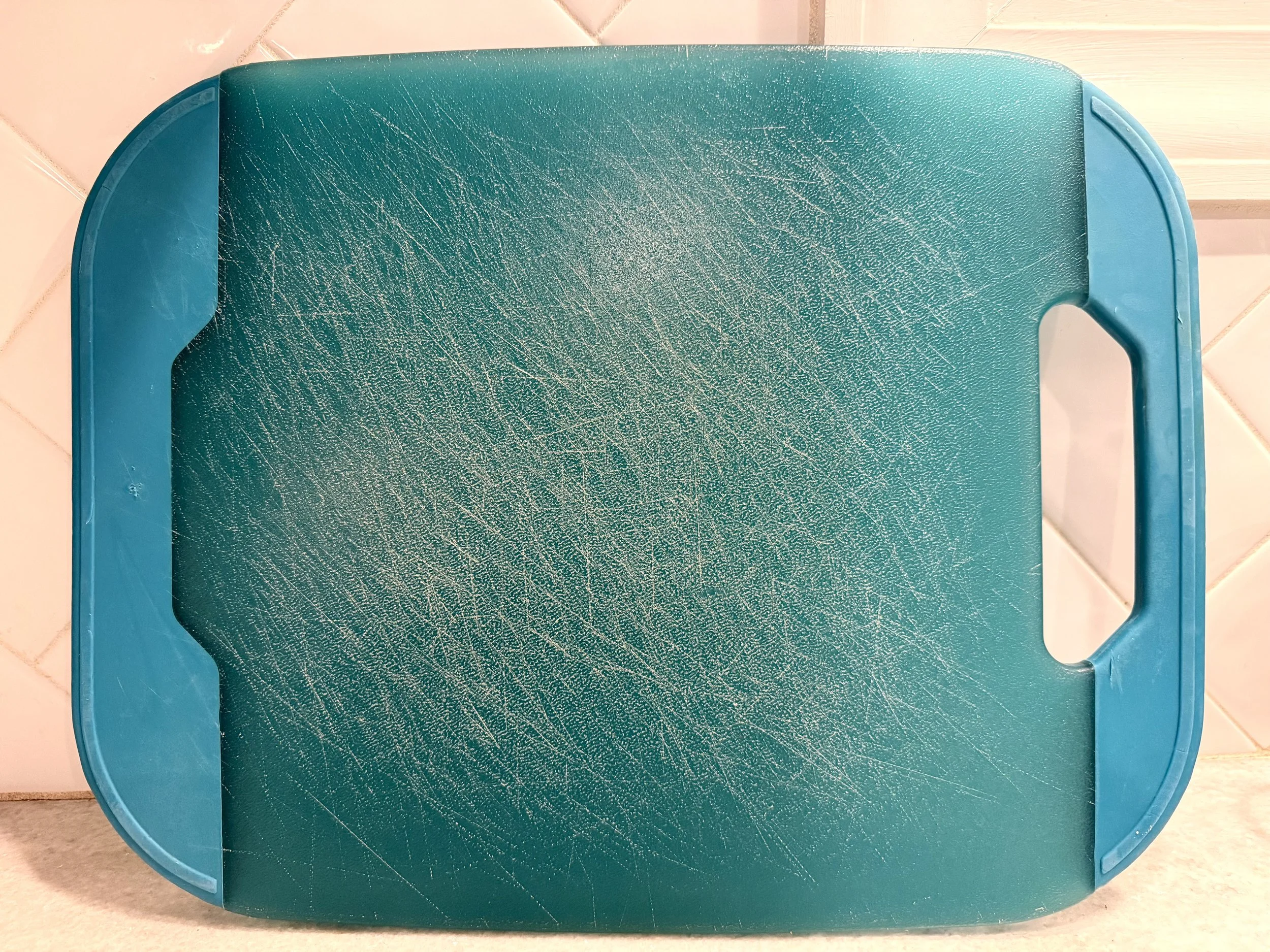
I get asked about this constantly at in person craft shows. People are increasingly wary of plastic in the kitchen, and for good reason. Here's a plain explanation of why wood is the better choice, and exactly what's in mine, so you're not just taking my word for it.
Why Move Away From Plastic
Plastic cutting boards shed microplastics every time a knife touches them. This isn't a fringe concern. A 2023 study published in Environmental Science & Technology found that chopping on a polyethylene board can expose a person to somewhere between 7.4 and 50.7 grams of microplastic per year, and a polypropylene board can run even higher. Every knife stroke carves tiny grooves into the plastic, and those grooves shed particles directly into whatever you're cutting.
Worth being straight with you here: wood boards shed particles too, and some research has actually found wood sheds more particles by count than plastic in certain tests. The difference that matters is what those particles are. Wood particles are natural cellulose fiber, the same material as the wood itself, and they break down like any other organic matter. Plastic particles are a synthetic polymer that doesn't break down and accumulates in the body over time. Switching to wood doesn't mean zero particles. It means the particles you're exposed to are wood, not plastic.
The Wood
I build primarily in black walnut, hard maple, white oak, and cherry, kiln dried and untreated. No chemical additives, no coatings baked in before it reaches me. (I've got a separate post coming that goes deeper on the woods themselves, if you're curious about grain, character, and why I chose these.)
A Note on Walnut and Juglone
A few people have asked me whether walnut is toxic, and there's a kernel of truth behind the question. Walnut trees produce a compound called juglone, which is why you'll sometimes hear that other plants struggle to grow near a walnut tree, or that pets shouldn't chew on fresh walnut branches, bark, or hulls. Both of those things are true.
What doesn't carry over is the toxicity. Juglone is concentrated almost entirely in a living tree's roots, hulls, and leaves. By the time wood is milled into heartwood lumber and kiln dried, the juglone left behind is negligible, which is exactly why walnut heartwood isn't restricted for food contact. The concern that's real for a living tree or fresh green wood doesn't carry over to a finished, cured piece sitting on your counter.
The Glue
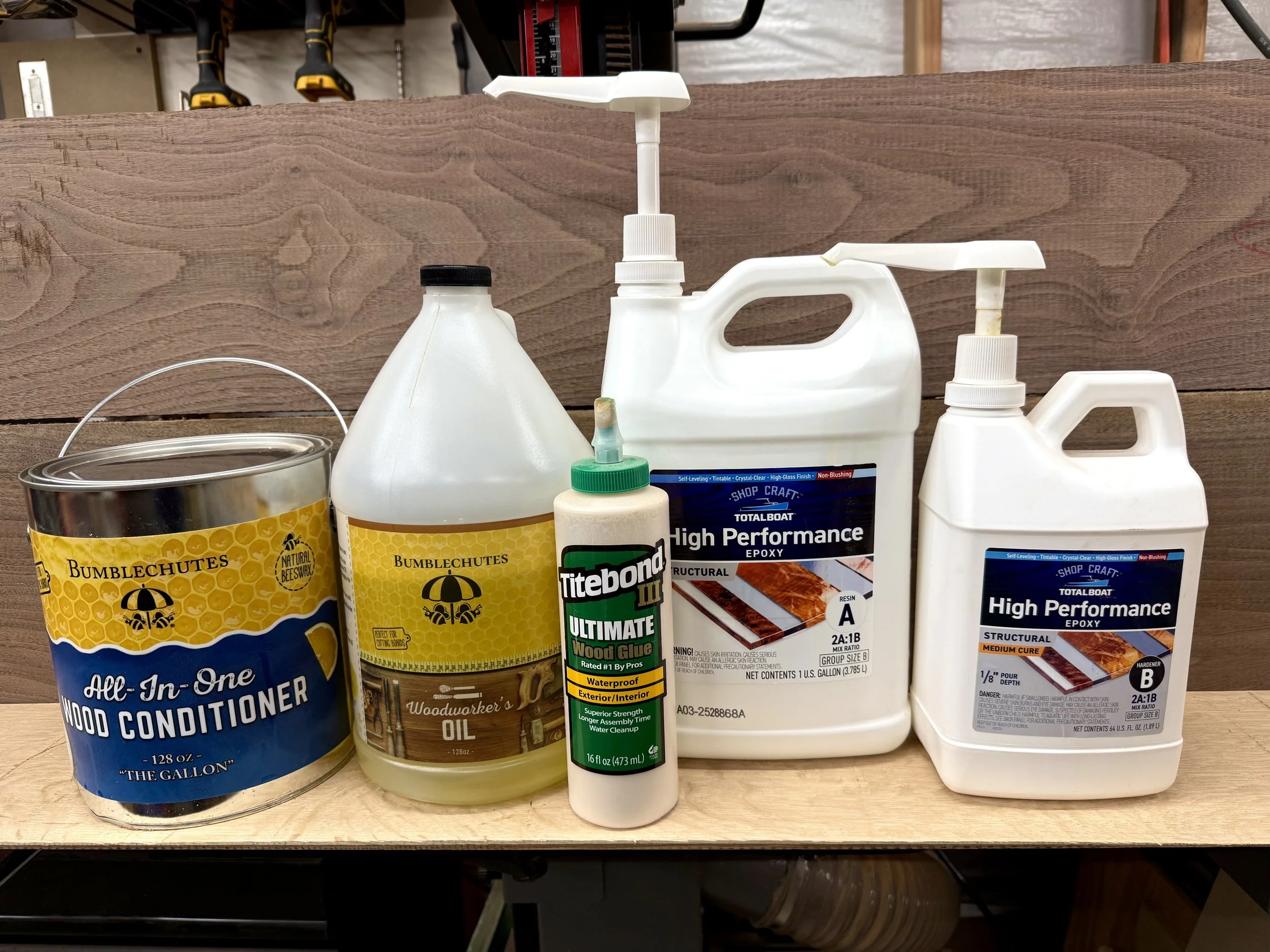
Where pieces are joined, I use Titebond III. It's FDA approved for indirect food contact once cured, meaning it's rated safe in the way it's actually used here: inside a joint, not on the surface your food touches. By the time a piece reaches you, that glue has cured for days, well past the 24 hours it needs to fully set.
If you'd still rather avoid glue joints entirely, my cheese slicers and charcuterie boards are cut from a single piece of solid wood with no glue lines at all. Worth noting these are built as serving pieces, not everyday cutting boards. A single-piece board is fine for something that's mostly on display and occasionally washed, but it's a poor choice for a board getting wet daily, since wide solid wood expands and contracts unevenly with moisture and is more prone to warping over time. That's part of why my actual cutting boards are glued up from narrower strips instead of cut from one solid piece.
The Finish
I finish everything with an oil, not a polyurethane or other film finish, and that distinction matters for the same reason the rest of this page does. A film finish, poly, lacquer, varnish, and similar products, cures into a thin layer of plastic sitting on top of the wood. It's not wood you're touching at that point, it's a synthetic coating over it. An oil finish works differently. It soaks into the wood fibers themselves rather than sitting on the surface, so what you're actually touching, washing, and cutting on is still the wood.
My standard process on cutting boards and charcuterie boards is two steps. The base coat is Bumblechute's Woodworker's Oil, made from fractionated coconut oil, mineral oil, lemon oil, and vitamin E. All of those are well-established food-safe ingredients, the kind the FDA classifies as GRAS, generally recognized as safe, including the mineral oil, which is food-grade and refined specifically for food contact rather than the industrial grade some people picture when they hear the term. Over that, I apply Bumblechute's All-In-One Wood Conditioner as a topcoat, a beeswax and carnauba wax blend that adds an extra layer of protection once the oil has soaked in. Like most small-batch wood finish makers, Bumblechute's doesn't carry a separate third-party certification on either product, since none is required for ingredients already recognized as safe.
On certain custom pieces, I'll sometimes use a hard wax oil instead of this standard process, something like Odie's Oil or Rubio Monocoat. It's a different category worth knowing about: still oil-based and still soaking into the wood rather than coating over it, but blended with natural waxes that cure a bit harder, giving a little more durability for a piece that'll see heavier handling. It keeps that same natural wood feel, just with a slightly tougher finish underneath.
For care and reoiling at home, two good options: Walrus Oil, or Bumblechute's Hydrating Wood Serum, which is made with fractionated coconut oil instead of mineral oil. Both are food-safe and well suited for maintaining a board. If mineral oil specifically is something you'd rather avoid, even though it's genuinely safe in its food-grade form, the Wood Serum is there as an option. I'm planning to carry it as an add-on for anyone who'd like one, though it's also available to source on your own. For the full how-to on when and how to reapply, take a look at my cutting board care instructions.
Skip cooking oils like olive oil entirely. They're non-drying, so they don't fully absorb and set the way a proper wood finish does. Over time they go rancid inside the wood, which leads to off smells and a sticky surface.
On Epoxy
Occasionally a piece has a small natural void or knot that needs filling to keep moisture out. When that happens, I use TotalBoat epoxy, applied only to the inner or outer edge of the piece, never anywhere a blade would touch. Worth knowing: no epoxy, food-safe or not, holds up to direct knife contact. It's harder than wood, and a blade will chip or shave it rather than glide across it. Any board sold with epoxy across the actual cutting surface should be treated as a serving piece, not something to chop on. My use of it stays confined to sealing small edge voids, well clear of where a knife ever goes.
Questions
If you're weighing a purchase and have a specific concern I haven't covered here, reach out. I'd rather answer directly than have you guess.
Sources
Cutting Boards: An Overlooked Source of Microplastics in Human Food? — Environmental Science & Technology, 2023
FDA GRAS status for food-grade mineral oil, 21 CFR 172.878 — U.S. Food & Drug Administration, Electronic Code of Federal Regulations
Titebond III FDA compliance for indirect food contact — Titebond / Franklin International